




[“LAID” BY JAMES PLAYS]
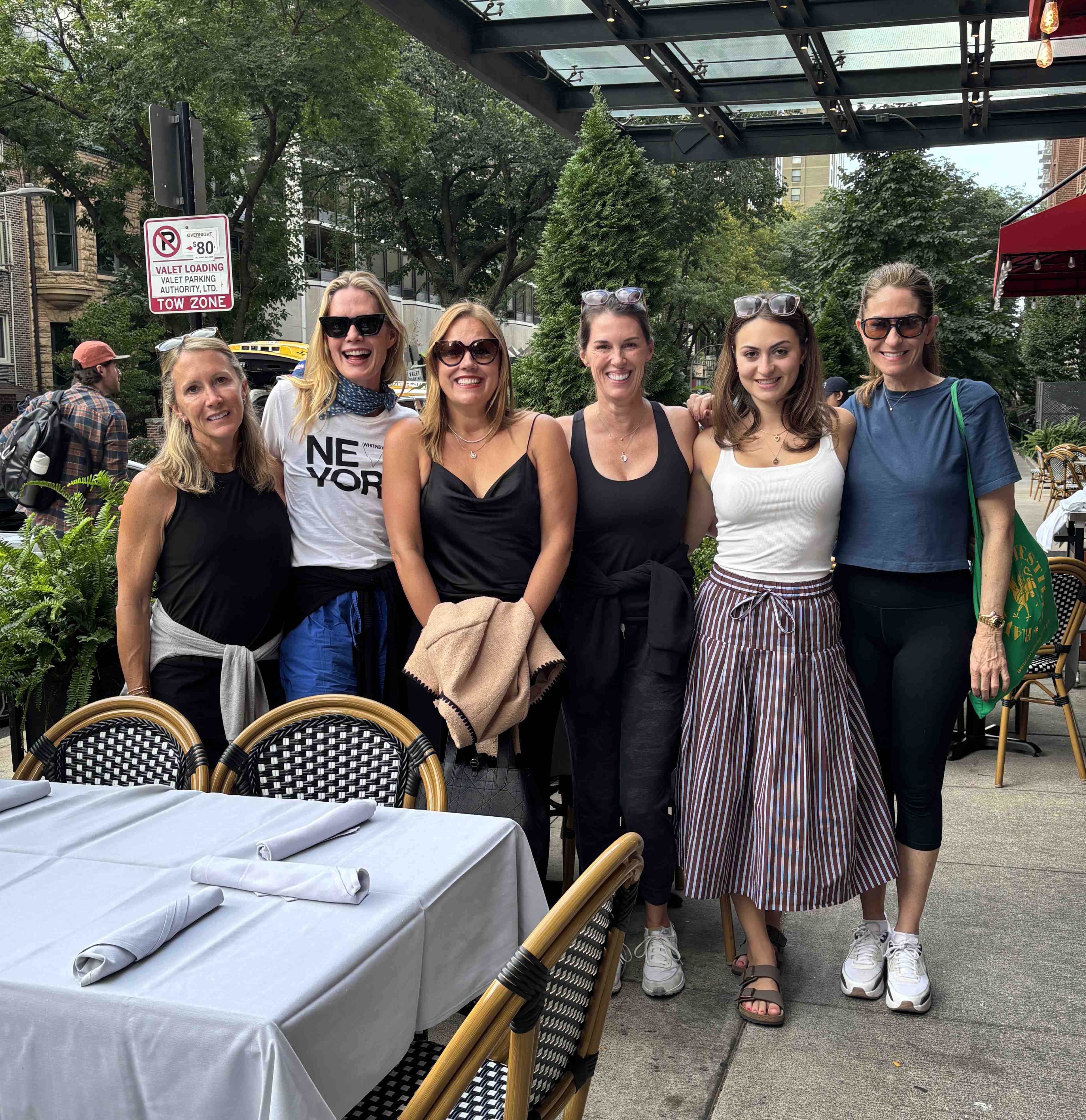
SYDNEY FENER: Hi. This is Sydney Fener with WNUR News and I am with– would you guys like to go around and introduce yourselves? So I’m class of 2026, if you guys want to say your graduation year, and maybe your major.
ROBYN FENER: Robyn Gold Fener, RTVF, ’95.
CASSIE FRICK: Cassie Wilcox Frick, CAS and Psychology major, ’96.
STEPHANIE MARCH: Stephanie March, Theater, Latin American Studies, ’96.
EMILY FOWLER: Emily Barwig Fowler, class of ’96, CAS, Environmental Science.
KAREN FANTER: Karen Faber Fanter, class of ’95, Economics and International Studies.
SYDNEY FENER: Wonderful. Well, thank you guys for joining me today. And can I just ask, What brings you all here? Why are we all here?
R.FENER: We are here for our 30th reunion from Northwestern, but only two of us are actually class of ’95 celebrating our 30th reunion, but the others like to just join in, because we’re such good friends, and we use this as an excuse to get together.
S.FENER: Cool.
MARCH: You can’t just see the people in your class, because so many of your friends are a class ahead or class. I say this is the one person who actually did not attend the reunion, but it matters enough to be, to be around these people that I came after the reunion, just to be with them.
S.FENER: Wonderful. So when you come back to Northwestern, what do you see as different? What do you see as still being the same? How do these changes present themselves?
MARCH: It feels like there are a lot of really hideous new buildings. They get a bit disorienting to be on campus and–
S.FENER: And name names, which are these buildings?
MARCH: I shan’t, I shan’t, because they were all generously donated to the university, but I do wish there was a little bit more architectural rigor when determining what the campus would look like.
MOSSBURG: And we’ve lost that open space.
FRICK: Especially lakefill space, yeah.
MOSSBURG: Well, I think part of that’s because of the fact that we have the temporary stadium that’s right there, which was gorgeous, but it is different to have such a big structure right on the lake, though, and it definitely made everything feel different.
R.FENER: Yeah, I agree, that’s– but frankly, the energy and the like, goodness and safety and, like, just general happy feeling of the place feels the same to me. But I gotta say, I– I think that there may be, like, sort of a lack of fun feeling like, I think there’s like a lot of sincerity and goodwill and nice kids and people are there to learn and grow, but it feels less fun. It just feels like there is less fun.
MARCH: It’s pretty serious. Yeah, it’s the business of being really smart.
MOSSBURG: And at the game, I feel like I saw a lot of alums and a lot of adults and even families with younger children, but there weren’t a lot of students that I felt like were present.
S.FENER: I was not at that game, and none of my friends were at that game, and I was asking around about tailgates, and everyone was like, “No.” That might be because I’m a senior and people are kind of tapped out, but, yeah, what? Who are we playing?
FRICK: Do you think the lack of student– do you think the lack of students at the game is because it’s a temporary stadium and, like, the lack of tailgating? Is it because there isn’t a home base right now, or is it just how the spirit of the school is?
S.FENER: You know, I think, honestly, if anything, I think that the proximity of the new stadium would be a draw for people, because schlepping all the way up to the old Ryan Fieldhouse, which it was a fun– it was a fun walk, for sure, but it was a journey for some people. Yeah, I’m not sure. I think that honestly, I mean, what I– something that I really, really love about Northwestern is that everybody is so involved and so passionate and so ambitious. But that does mean that people take on a lot and are super busy. And like, when I talked to my friends about what they were doing on that Saturday morning, it was like everything but going to the game. Like, I have to be on set. I’m handling callbacks for, like, a comedy group I’m in, I have, you know, I’m working on my thesis, and it’s awesome that people are doing all of that. But it’s also like, who wants to stand in a backyard? And, like, I don’t know, // and just veg.
SEVERAL: We do, yeah. We seem to still be doing it. That sounds– That’s a big thing we do when we get together.
S.FENER: So my next, my next question is, what has the alumni community meant to you in the years since you graduated?
FRICK: Everything, absolutely everything. //
SEVERAL: Yeah, agree, everything.
FRICK: Everything good from– you said this the other day, Robyn, everything good for my life came from here in one way or another.
R.FENER: I couldn’t be more proud of being a Northwestern alum. I love Northwestern. I’m supportive in every way I can be. There’s a few things I wish that we were doing better and doing differently, but by and large, I bleed purple and have my Northwestern license plate frame, and I get thrilled whenever I meet an alum anywhere in this world, and people are doing cool stuff, and it’s, it’s like just a badge of honor to be a member of this community.
S.FENER: Next, I want you to tell me about places on campus that hold really vivid memories for you, like just being there, you’re like, Oh my God.
R.FENER: Like every step, every inch–
MARCH: –like, 1000 things flashing through your mind, Arch to the Rock, to Norris, which hasn’t been improved in 700–
R.FENER: It’s actually worse now.
S.FENER: What do you mean? There’s literally a pizza place there now, so–
FRICK: But there was a Taco Bell, so I don’t know. How do you think I survived college?
R.FENER: But not only have I had memories, they’re like– incredible memories every inch of the campus when I was there for four years. I remember going there with my parents when I was seven years old, and my mom–
S.FENER: Me too!
R.FENER: That’s right! And we went with Faber, one of the other panelists here, and her daughter was– Mia was four– //
FANTER: When she was tiny, three.
R.FENER: Yeah. So I have memories of like, before I was there, and I have memories after I was there, showing my daughter. And now all these reunions we have, like, a lot of reunion memories under our belts at this point.
FRICK: Too many. More than we should. A lot of reunion. A lot of years.
R.FENER: I’ve come every single one. 5, 10, 15, 20–
MARCH: Have you really?
R.FENER: Of course.
S.FENER: Anything, like, specific, like you, like, walk somewhere, and you were like, oh my god, like, you stood somewhere, I don’t know.
MOSSBURG: I mean, I think that as we were walking to the game and back from the game, across the lakefill with the water and the rock fill and all of it, like, I think we all were like, “Oh my gosh, did we do we remember how pretty this was?” Like, did we really understand how gorgeous of a place that we had the opportunity to go to school. We’re like, did we come down here enough? Maybe we should have come down here. It’s really something.
S.FENER: That’s awesome. Yeah. I guess the last question would be, what advice do you guys have for me as somebody who’s about to graduate? Like, what should I do in my last year? What should I think of?
FRICK: Stay right there? Anybody that ever asks, never leave.
MARCH: Stay in touch with your alumni community, because you never even– even people you don’t know right now who are in your class or a class behind you or ahead of you. You never know how your paths might cross, and whether it’s a job or your children know each other, or you meet each other you know in a foreign city and you happen to be on the same– who knows? But there are ways that people have of crossing paths who are alumni of the school, and it’s really surprising and kind of wonderful.
FANTER: Drink it up, soak it in.
R.FENER: I’m so glad that, like, our school isn’t teeny tiny, but it’s also not like Ohio State or something where you have like, 100,000 people that also are doing like, it’s kind of special. It’s sort of special. Yeah, it’s a sweet spot, size wise, where, like, you go out into the world, and it’s not like, oh, anybody here could have gone, oh, like, this giant school, like, we went to this special place and special time. And, I mean, I gotta say, I think the ’90s ruled. It did. Like, I’m so happy we were there in the 90s–
MARCH: Without phones. //
SEVERAL: No, yeah, it was the best, yeah, yeah.
R.FENER: And, of course, which– I don’t have to worry about you like this, but don’t take it for granted.You know, pause and appreciate the moments, but you’re good like that. Yeah, give back to your community. It’s worth it.
S.FENER: Okay? Well, on that lovely note, I think we will leave it there. Thank you all so much for joining me. This has been a wonderful conversation. And yeah, go cats.
SEVERAL: Go cats!
S.FENER: For WNUR news, this is Sydney Fener signing off.
[“IN A DAYDREAM” BY FREDDY JONES BAND PLAYS]


