


On October 14th, the Block Museum played “Les Vampires,” a silent film that’s over a century old.
On the night of the screening, the theater was full and buzzing with anticipation. Audience members chatted and laughed as they waited.
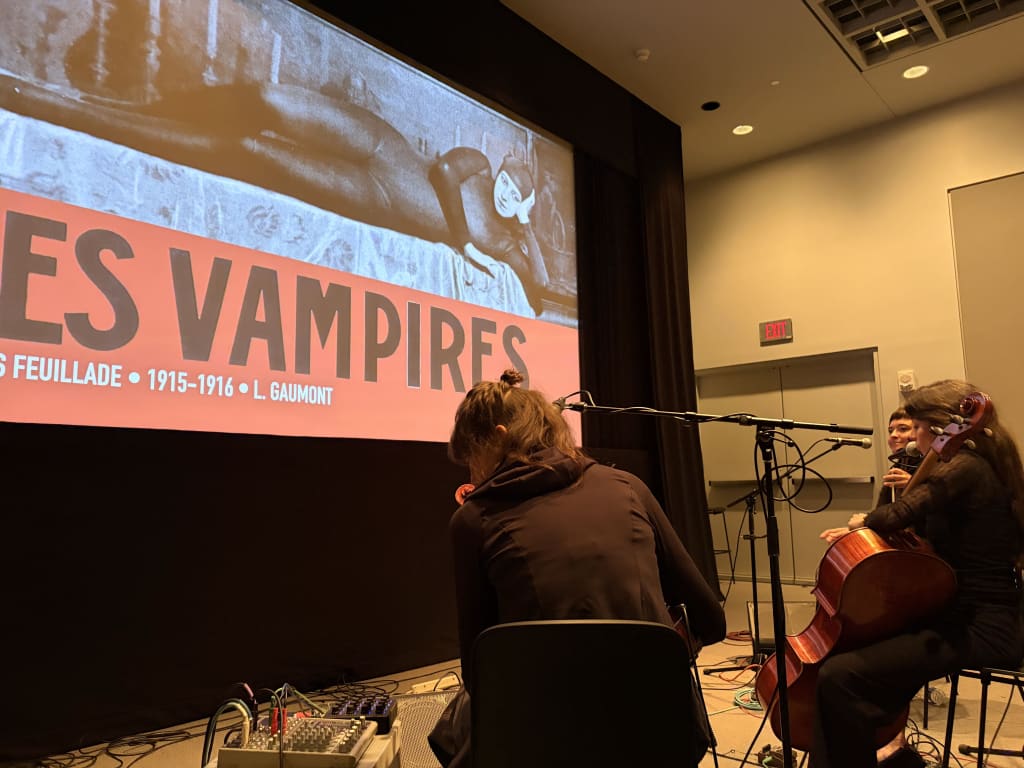
Sitting at the front of the room, with similar anticipation, was a collection of instruments and electronics.
This wasn’t just a silent film, it was one with a live score by musicians Macy Stewart, Lia Kohl and Whitney Johnson. But how do you make a soundtrack to a silent film?
According to Johnson, a sound artist and assistant professor at the School of the Art Institute of Chicago, it’s not just like any other piece of music.
“It’s not scored in like a traditional compositional sense. It’s not like on, you know, on paper on five lines,” Johnson said, “Our process is to like watch the film together, get a sense of the plot, get a sense of like the big moments, and also the emotional arc of kind of what’s happening, and then come up with some ideas in conversation, and then have that as a score.”
Scoring something like Les Vampires has its challenges. The film is actually episode five in a 10 part serial, which when played in totality runs about 7 hours long.
The solution: forget the plot.
“We thought that would be there’s not really a way to build that from the ground up, for people who just show up at the cinema that day, maybe they haven’t really read even like the plot summary,” Johnson said, “We’re taking it at an emotional and aesthetic and mostly visual level.”
This experimental music score was the main pull for many audience members.
Donna Spiegel, who usually comes to the Block for their lectures, came here for the music as much as the movie.
“I’m interested to see the intersection of the music and the film,” Spiegel said, “I’m very curious about the film and just the idea that they’re gonna be playing live with it.”
Nathan Abhalter Smith, another audience member, was similarly interested. Smith said that seeing a live score is “always rare and interesting and changes how you see the film.”
As the audience filled the room with applause, the movie began. It was, to be frank, very confusing, with a multitude of characters and things happening all the time. Audience members watched a hostage situation between criminal masterminds, a 200,000 franc stolen treasure, and a hypnotized maid.
What was arguably more interesting, though, was the way the music accompanied the film.
Throughout, long and droning synth waves played, creating a mood of eeriness in the theater. The musicians added sound effects using vocalizations, tapping, and a whole lot of help from an array of electronic loop pedals and mixers.
According to Macie Stewart, one of the musicians for this playing of Les Vampires, the process for making the soundtrack is unique.
“I love doing live scoring, and, you know, improvising is a huge part of our practice, and so the score was largely improvised,” she said. “I think a lot of the time when we’re doing things like this, when I’m doing things like this, I’m thinking of the emotional undercurrent of a scene, or what’s about to happen next, and thinking about that helps kind of focus the improvisation.”
This type of musical improv has a way of making older content more engaging for a modern audience.
According to Michael Metzger, the Pick-Laudati Academic Curator for Cinema and Media Arts, that goal was the driving force behind the event.
“I wanted to feel more like, oh, we’re bringing something to life and there’s an opportunity for people to feel, like, this is speaking to where they are in this moment,” Metzger said. “Hopefully people will have this sense that, you know, a film made in 1916 doesn’t have to feel like a museum piece. It can feel really vibrant and like present and contemporary.”