


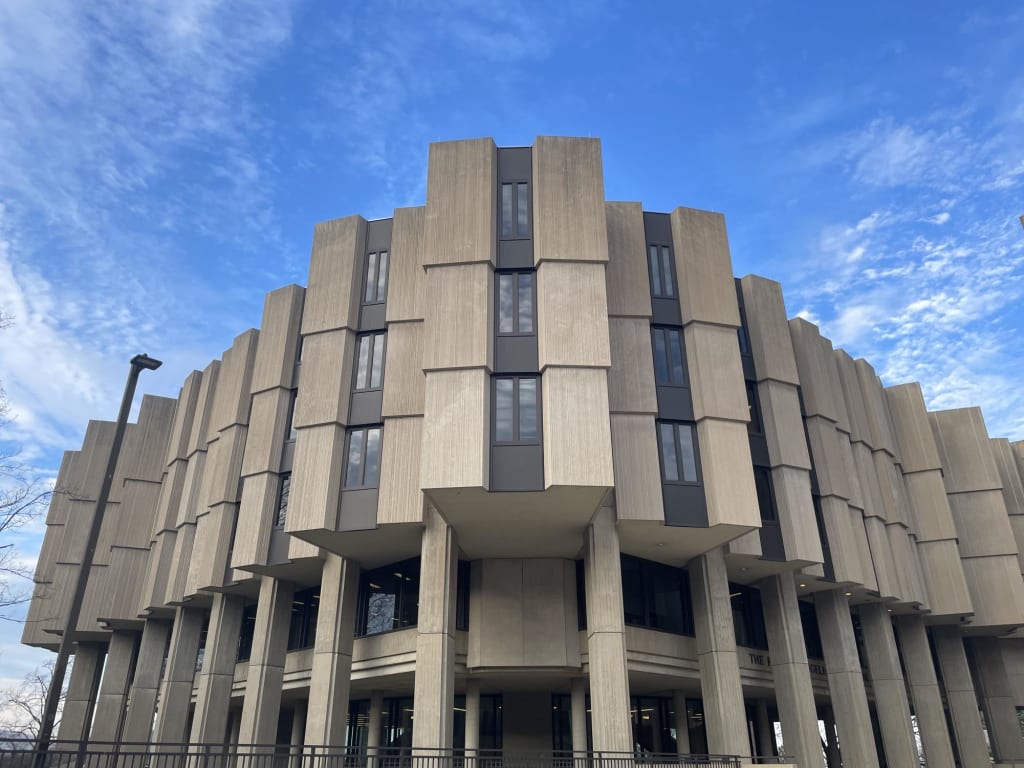



Northwestern University seems ripe for myths and legends — with 175 years of traditions to pull from. I spoke with campus historian Kevin Leonard to uncover this hallowed history. His office sits in the University Library, the center of one of Northwestern’s most common myths.
“That myth is that the library is sinking. And the story is that the architect built this massive edifice, but had forgotten to calculate the weight of the books once they would be installed into the building. And then with the weight of the books installed, the building slowly started to sink back into the ground,” said Leonard.
Ami Bauman, ‘86, recounted the same myth.
“The big one was that the library was sinking because they forgot to account for the weight of the books,” said Bauman.
But Leonard says this tale is not specific to Northwestern. Many other universities have some variation of this myth.
“The theme that you have is authority, expert knowledge, falling short. And perhaps that’s appealing to a younger person: the more adult, experienced world, it’s not all that it’s cracked up to be,” said Leonard.
Jen Healy graduated from the School of Speech, Communicative Sciences and Disorders in 1993. As a part of its curriculum, students in the school worked with cadavers. She recalls a more morbid rumor.
“A lot of pre-med kids were in the School of Speech with us because that’s a way they could work on some of the cadavers. So there were always rumors and myths about bodies in the basements of Tech,” said Healy.
The Technological Institute, commonly known as Tech, is the biggest building on Northwestern’s campus and, appropriately, home to some equally tall tales. Greg Fisher, ‘90, remembers one myth.
“I did hear some stories about some tunnels lurking underneath the Tech Institute, but nobody ever confirmed those or found them, to my knowledge,” said Fisher.
The iconic Deering Library has also been the subject of some misattributed remarks.
“The account is that Frank Lloyd Wright said that Deering looks like a pig on its back. And if you step back from Deering, you can understand why he would compare it to that, with stumpy little legs pointing up in the air. Frank Lloyd Wright didn’t say that. A guy named Larry Wright did,” said Leonard.
Larry Wright taught in the English department at Northwestern in the 1930s. Over time, his statement has been twisted to malign a famous architect who never actually bad-mouthed Deering.
But these relatively tame, building-based myths seemed to be the best alumni had to offer.
“I honestly don’t remember anything, and that could be partly being 55. Or there just weren’t that many swirling,” said Healy.
Fisher had a similar experience.
“I tried thinking about this, and talking to a lot of friends and my brother, who also went to Northwestern, and we couldn’t come up with any real good ones,” he said.
Leonard has a theory as to why Northwestern, despite its long history, doesn’t have many campus legends.
“This college, and the town around it, in the 19th century and early 20th century, was very heavily Methodist. And very pro temperance, very pro abstinence. And so, minus a sufficient number of drunks and people who might be put into a more imaginative state, you have very sober people. Well, no one’s seeing any ghosts, right?” he said.
But perhaps this means there have been more clear-eyed chroniclers—and that many interesting, true stories about Northwestern are out there, yet to be uncovered.