

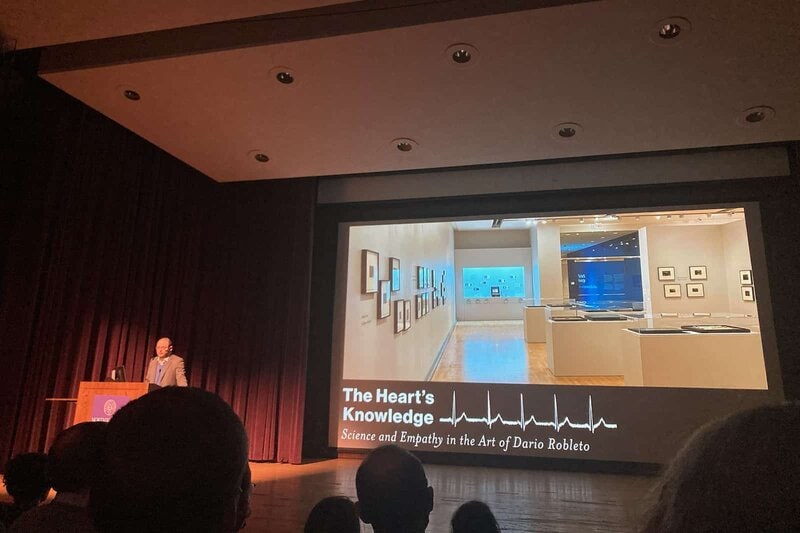
The Block Museum of Art held a conversation with artist Dario Robleto regarding his latest exhibit, “The Heart’s Knowledge.” Emily Stull has the story.


[heart beat thumping]
[newdawn space music: Benjamin Tissot]
[aorta of the archivist] “A threshold. The Unattainable. A distinction with profound consequences. We do not know this threshold’s texture: is it more a veil or mist? Stone or breath? But we know it is moving. Forever racing away from us”
[Lisa Corin] In the darkness, precociously pondering, a fundamental question of human existence. “What is life? What happens when we shuffle off this mortal coil” to quote Shakespeare. “Is there life out there in the universe, beyond the … magnificent desolation?”
THIS IS LISA CORIN, THE ELLEN PHILIPS KATZ EXECUTIVE DIRECTOR OF THE BLOCK MUSEUM OF ART. ON FEBRUARY 4, SHE INTRODUCED ARTIST DARIO ROBLETO IN A PUBLIC CONVERSATION REGARDING HIS LATEST EXHIBIT, “THE HEART’S KNOWLEDGE.” YOU JUST LISTENED TO ROBLETO DISCUSSING THE “ATTAINABLE”, WHICH IS THE MARGIN OF SPACE WE CAN REACH AND OBSERVE, THOUGH FOREVER MOVING AWAY AS THE UNIVERSE EXPANDS. THIS CLIP IS FROM THE EXHIBIT’S FILM COMPONENT CALLED “THE AORTA OF THE ARCHIVIST,” WHICH IS FEATURED AT THE BLOCK MUSEUM OF ART. THE EXHIBIT IS A RESULT OF A FIVE-YEAR COLLABORATION BETWEEN ROBLETO AND THE MCCORMICK SCHOOL OF ENGINEERING
FROM SAN ANTONIO, TEXAS, ROBLETO HAS BEEN FEATURED AT INSTITUTIONS ACROSS THE COUNTRY AS A LECTURER AND VISITING ARTIST. THE MEDIUM OF HIS ART CAN RANGE FROM SCULPTURE TO FILM. HE CENTERS HIS WORK ON THE HUMAN EXPERIENCE AND NATURAL WORLD.
AS AN ARTIST-IN-RESIDENCE, ROBLETO WORKED CLOSELY WITH STUDENTS IN STEM IN HIS EXPLORATION OF THE HEART, AND IN THE CREATIVE PROCESS OF THE EXHIBIT.
JULIO OTTINO, THE DEAN OF THE MCCORMICK SCHOOL OF ENGINEERING, HELPED SPEARHEAD THIS COLLABORATION.
[Julio Ottino] Dario brought curiosity, incredible talent, and … for an artist what is real humility.
HARVARD ART HISTORY PROFESSOR JENNIFER ROBERTS ALSO ATTENDED THE DISCUSSION. SHE HAD ASSISTED ROBLETO IN THE PROCESS OF MAKING THE EXHIBIT.
[Jennifer Roberts] It’s not only an artist-at-large but an artist in residence so an artist … who’s moving around the campus and making connections which is so important.
ROBLETO CHALLENGES THE VIEWERS TO CONSIDER HOW THE SCIENTIFIC AND ARTISTIC FIELDS BREAK BOUNDARIES IN A SIMILAR WAY, THROUGH SEEKING TO UNDERSTAND THE WORLD AROUND US.
IN THE CONVERSATION, ROBERTS SUGGESTS THAT…
[JR] Artists are the best people to build these bridges because artists aren’t tied to any particular discipline.
THE EXHIBIT EXPLORES THE INTERSECTIONALITIES BETWEEN SCIENTIFIC AND ARTISTIC EXPLORATION, AND HOW THE TWO FIELDS MIGHT BE MORE RELATED IN THEIR ASPIRATIONS THAN PREVIOUSLY CONSIDERED. HE USES THE DISCUSSION OF THE HEART AS A WAY TO ILLUSTRATE THIS COMPARISON.
[Dario Robleto] The study of a heart–which for millennia has been argued over by philosophers, priests and artists–science generally avoided really digging into it unless it was philosophical because they couldn’t record it. I like to say that the heart was its own unobservable universe problem for a long time.
I TALKED GRETA BELL, AN ARTIST AND FRIEND OF ROBLETO’S, WHO ATTENDED THE CONVERSATION WITH CONKLIN. BOTH SAID THEY WERE NEARLY SPEECHLESS FOLLOWING THE EVENT.
[Greta Bell] He incorporates time. The future, the present, and the past all with the heart and how we’re all connected. I don’t know how he does it.
[Lia Conklin] He’s putting words and thoughts into things I’ve never been able to express. So when you hear it, you react like “woah, that’s a truth. I want to sit with that for a little bit.”
HE FOUND UNITY BETWEEN THE SCIENCE AND ART WORLDS THROUGH DIALOGUE OF EMPATHY, AND EXPLORATION OF THE HUMAN RACE’S CAPACITY TO BE EMPATHETIC.
[DR] Nothing has challenged me more to think empathetically than imagining the ultimate “other” of alieness. Where you share no sensory experience or context similarities or emotional range.
ROBLETO UNITED ARTS AND SCIENCE IN THE COUNTER AGAINST “THE ATTACK ON EMPATHY,” AS HE CALLED IT, WHICH WE ARE CURRENTLY FACING.
[DR] We should assume that [empathy] is actively being attacked by new technologies. Empathy needs to be innovated. We need to innovate the ways we express it.
[LC] The Block’s modus operandi is … to catalyze this profound questioning, especially for our students. To cultivate self knowledge, and the capacity for empathy.
[DR] What is the actual boundary li ne of the human capacity to empathize? I don’t think we even scratch the possibility of it.
FOR WNUR NEWS, I’M EMILY STULL.


